Great muscles to know: the "pear-shaped" piriformis
 Jason Ray Brown
A flexible piriformis will add more sukha (ease) to your Sukhasana and make postures like Pigeon more accessible.
While I probably shouldn’t have favorites, I do confess to having a special fondness for the piriformis. It’s got a super cool name that just kind of rolls off the tongue, it feels great to stretch it, and when it’s flexible it’ll add much more sukha to your Sukhasana (Comfortable pose) and make postures like Ekapada Rajakapotasana (Pigeon pose) more accessible.
However, if it’s tight it will limit the ability of the femur to laterally rotate within the hip joint, which has a lot of potentially not-so-great consequences (both on and off the yoga mat).
By taking the time to learn more about this little muscle you’ll be able to more skillfully stretch it in your own practice and help your students find ways to safely stretch it in theirs.
WHERE IT IS
The piriformis is one of six muscles located deep to gluteus maximus on the posterior aspect of the pelvis. It attaches from the anterolateral aspect of the sacrum to the greater trochanter of the femur.
6a00f9ce2d836_lg.jpg)
WHAT IT DOES WHEN IT CONTRACTS
- Lateral rotation of the thigh at the hip joint
- Medial rotation of the thigh at the hip joint*
- Horizontal abduction of the thigh at the hip joint*
61533fd1aceb7_lg.jpg "The Piriformis Muscle")
*Most anatomy sources only list the standard actions of the piriformis from anatomical position, which is that it can laterally rotate the thigh at the hip joint. However, when the thigh is sufficiently flexed the line of pull of the piriformis changes and it becomes capable of medially rotating and horizontally abducting the thigh at the hip joint! How is this possible? Well, when the thigh is flexed beyond 60° the distal attachment of the piriformis starts to move anterior to the axis of the hip joint, which changes its line of pull (see image, right). As a result, when the piriformis contracts and shortens it pulls the lateral aspect of the femur anteriorly, which medially rotates it!
HOW A TIGHT PIRIFORMIS MANIFESTS IN ASANA
Sukhasana (the "comfortable posture")

It’s pretty easy to tell if someone has tight piriformis muscles — just observe them sitting in a cross-legged position like Sukhasana. Because the thighs are flexed significantly in this posture the piriformis muscles have become medial rotators, which means that if they're tight then lateral rotation will be limited and the knees will be higher than the hips:
615341222dedc_lg.jpg "Modified Sukhasana with Props")
Elevating the pelvis on a bolster or two would be very helpful, as it will decrease the amount of lateral rotation necessary to sit comfortably. When elevating the pelvis, finesse the height of the props so that the pelvis is the same height as the knees. You could further support the posture by placing a rolled blanket underneath the crossed legs:
Virabhadrasana 2 (Warrior 2)
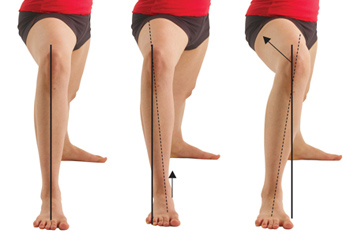
In Virabhadrasana 2 (Warrior 2), the lateral rotators of the front hip need to contract to help align the front knee with the 2nd toe of the front foot. If the lateral rotators are weak, or if the piriformis is tight, this will be difficult to do and will likely result in the knee drifting medially. If this happens, you could have the student turn the pelvis slightly toward the front of the mat in order to more easily align the knee with the 2nd toe.
KNEE PAIN IN PIGEON AND RELATED POSTURES
As we’ve been discussing, if the piriformis is tight it will limit lateral rotation of the femur when the thigh is flexed. Think of all the postures in yoga that this would effect! Bada Konasana (Bound Angle pose), Janusirshasana (Head-to-Knee pose), Ardha Matsyendrasana (Seated Spinal Twist), Gomukasana (Cow-Faced pose), Padmasana (Lotus) and all related postures, Eka Pada Raja Kapotasana (Pigeon pose), and the list goes on.
And here’s the thing: in all of these postures, if lateral rotation is limited it is very likely that the medial meniscus will get compressed and that the lateral collateral ligament (LCL) will be overstretched (see illustration below showing these tissues). To get a little more insight into how this might occur, also be sure to check out the video Keeping the Front Knee Safe in Pigeon.
-copy6a00fb78dc743_lg.png)
HOW TO STRETCH THE PIRIFORMIS
The easiest way to stretch the piriformis is to first flex the thigh beyond 60° to turn it into a medial rotator, and then to laterally rotate the thigh at the hip joint. Keeping in mind that when the thigh is flexed the piriformis can also horizontally abduct, we would also want to minimize horizontal abduction or perhaps even add a little bit of horizontal adduction in order to make the stretch more effective. If you have a tight piriformis, or if you experience knee pain in Pigeon pose, try these variations:
PIRIFORMIS SYNDROME
The last thing I’d like to share with you about the piriformis is a pathology that is very similar to sciatica. Sciatica manifests as traveling pain along the posterior buttocks, thigh, calf and foot that has a kind of tingly, electric pain that seems to move around. It is most often caused by a herniated disc or stenosis in the lumbar spine, which puts pressure on the sciatic nerve. With piriformis syndrome, there is also pressure on the sciatic nerve that creates the same symptoms, but the cause is a tight and/or inflamed piriformis muscle… not a disc pathology.
As usual, we appreciate any thoughts, questions or feedback you have. Om Shanti!
Categories: : Yoga Anatomy
Continue Exploring
This writing is part of a broader body of work exploring:
- resilience and habit change
- mindfulness and meditation
- living wisdom
- movement and nervous system regulation
- functional anatomy
- continuing education for yoga teachers
You can explore current programs, courses, and live offerings here.