How to Stay Human When the World is on Fire
 Jason Ray Brown
A reflection on nervous system regulation, resilience, and staying grounded during times of political and social upheaval.
The world seems so upside down right now.
Maybe it's always been like this in one way or another, and most of us have just been blissfully ignorant about it for most of our lives. When I was growing up in the 70s, there were only three major networks in the U.S., and they only broadcast news-related programs once or twice per day for about 30 minutes. Some people got news by reading the paper in the mornings, or at least The Sunday Times, but many would just skim the headlines and then go straight to their favorite section. Mainlining the political and international news just wasn't a thing, so most people weren't really aware of the details of the suffering people might be experiencing.
The 24/7 news cycle
CNN came on the scene in 1980 offering round‑the‑clock news coverage, and after blowing up with their coverage of the Gulf War in the early 90s, MSNBC and Fox launched to get in on the action. So, quietly and seemingly overnight, news headlines just started streaming into our lives full time.
But even then, we were still able to maintain some degree of ignorance about the facts and details of world events, due to the likelihood that most cable news programs were filtered and curated based on financial bottom lines, political influence, or even just FCC restrictions on displaying graphic violence.
The rise of smartphones and social media
Sometime in the early 2010s, smartphones became a thing and suddenly the internet, and everything on it, lived in our pockets. And then came social media. Twitter and Facebook, and then eventually Instagram and TikTok, made it possible to witness firsthand the raw, shaky, uncensored footage right from the midst of a protest or disaster zone—in our own backyard but also on the other side of the world. And due to the development of algorithms that quickly figured out what kept us glued to the screen, it didn't take long before many of us became addicted to a constant stream of first‑person, up‑close videos: someone fleeing a flood in Florida, a mother and child dodging bombs in Gaza, a gang of ICE officers abducting people in broad daylight.
Suddenly, we weren't just hearing about events from a polished anchor in a sterile newsroom... we were seeing them through the eyes of people actually living through those events, often within minutes of them happening or even live-streamed.
The sad truth
None of what we're seeing is new. Political corruption, injustice, human rights violations, colonization, forced displacement, and even genocide have been happening for centuries. The difference is that for most of our lives (especially if we grew up in relatively safe, insulated corners of the U.S.) we were largely unaware of it most of the time.
But now? The atrocities of the world get delivered right to the device in our hands, twenty‑four hours a day, seven days a week. And not as dry headlines or filtered reports, but as raw, visceral, looping video that is often graphic and emotionally charged.
How do we stay grounded through all of it? How can we stay emotionally connected to the people, jobs, and hobbies we care about when the craziness in the headlines makes us just want to pull our heads in like turtles... and wait for everything to get better before we emerge again, ready to resume our lives?
You're not alone
If you're feeling overwhelmed, anxious, angry, or just numb, you're not alone. The constant "shock and awe" of destabilizing executive orders and governmental overreach is taking a toll on many of us. There are unprecedented levels of social and political upheaval, and we're all just trying to navigate it somehow.
For some people, that may mean withdrawing for a while... binge-watching Netflix, venting over drinks with friends, or processing everything in a therapist's office. For others, it may mean taking direct action by writing elected officials, joining a protest, creating content to spread awareness, or directly helping an immigrant or a transgender person. But here's the thing: regardless of how you choose to navigate these times, it's important to find ways to take care of your own health and mental well-being.
I'm not talking about navigating difficult emotional challenges with a "good vibes only" attitude to gloss over injustice or avoid the hard work of accountability and change (i.e., spiritual bypassing). Stress-reduction and wellness practices aren't escape hatches. They're anchors. They keep us grounded and stable so we can stand toe-to-toe with the world's challenges, with the strength and presence of mind required for times like these.
Because the truth is, the challenges we're facing today aren't going away anytime soon. It's going to take time to turn things around, and even when this moment improves, new challenges are going to arise and demand action. So it doesn't make sense to just put our lives on pause until it all somehow gets better.
One of the most important things we can do in this moment, right now while all the chaos is spiraling around us, is to learn how to ground our nervous systems, regulate our emotions, and keep loving, working, relating, and living as fully as we can.
Baseline practices
Journaling, meditation, and some form of exercise or movement practice can be very helpful for stress reduction and nervous system regulation. If you can get up early, journal about the personal and global challenges on your mind, do some calm‑abiding or loving-kindness meditation, and then move your body in some way, you'll most likely feel pretty great afterward, and more capable of dealing with the challenges in your life and in the world.
We can think of a morning routine like this as the thing that gives our nervous system its baseline stability and resilience. If we were a tree, our morning routine would help us grow deep, strong roots, so that when the storms come we don't get blown away. If we skip that routine, our day might not flow as well and we're more likely to get triggered during challenging moments.
However, even when we're on our game and practicing regularly, there are still going to be times when we get caught by a persistent thought or emotion that we just can't seem to let go of, and that thought is likely going to cause us to feel some combination of anxiety, fear, or depression.
During such moments, knowing a few of the real‑world, in‑the‑moment psychological resilience skills found in ACT (Acceptance & Commitment Therapy) and DBT (Dialectical Behavioral Therapy) can be invaluable. While such skills won't change the external circumstances, they have great potential to change how you relate to those circumstances internally, on a mental and emotional level, which then ties directly into how you're able to show up in that moment.
Let me give you a couple of examples from each, to give you a better sense of what I'm talking about.
From ACT: "I'm having the thought that…"
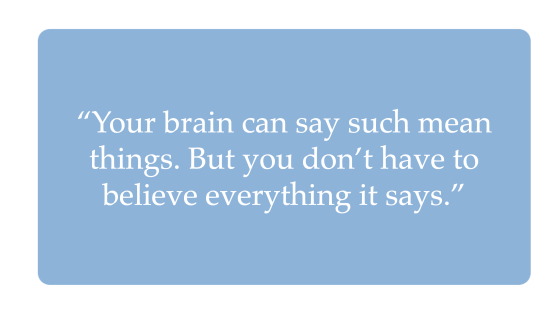
ACT teaches us that a thought is just a thought, and not a direct representation of reality. When we're doomscrolling on TikTok or Instagram about the downstream effects of policies being enacted by the current administration, and our brain says "this is going to cause so much harm," or "it's going to take decades for us to turn this around," our tendency might be to believe that thought as if it represents Truth with a capital T.
ACT refers to this tendency as fusion. We fuse with a thought when we identify with it so much that it feels real. In these moments, a helpful technique we can employ is to create a bit of distance between ourselves and the thought by adding the words, "I'm having the thought that…" at the beginning.
For example:
"This is going to do so much harm," becomes
"I'm having the thought that this is going to do so much harm."
"Younger generations in this country are doomed," becomes
"I'm having the thought that younger generations in this country are doomed."
This might seem like a small change, but it creates a little space between you and the thought. In that space, you might be able to realize: "Oh, this is a thought that my angry brain is producing at the moment. Not a fact. Not a prophecy of what will actually happen. It's just a thought."
It sounds almost too simple, but it works because it doesn't try to argue the thought away. It just changes the relationship to it, allowing us to stay more steady, which gives us more control over our next response in that moment.
From DBT: TIPP for acute overwhelm
Then there are the moments when a thought isn't the problem. Something happens that causes our whole nervous system to catch on fire... our chest feels constricted, our jaw tightens, and our breathing starts to quicken. In those moments, we may not have the wherewithal to hop on a yoga mat or meditation cushion, and if we tried to journal we'd probably just break the pen… or our tears would create a river of ink on the page.
Such moments require a physical off‑ramp that we can jump on quickly.
That's where TIPP comes in, which stands for Temperature, Intense exercise, Paced breathing, and Paired muscle relaxation. All of the TIPP exercises are designed to rapidly shift the nervous system out of fight‑or‑flight mode and back to relaxation mode.
Temperature offers one of the fastest off-ramps during moments of overwhelm, if you have access to cold water or ice. One technique is to fill a bowl with cold water and immerse your entire face in it. This works by triggering the mammalian dive reflex, which physically slows down the breath and heart rate, allowing you to immediately feel more grounded. Holding a hot mug is also an option if you're not super overwhelmed and just want a bit of comfort.
The other letters can help as well. For Intense exercise, just try running in place for 30 seconds or doing some jumping jacks to get your heart rate up, as the post-exercise drop in heart rate creates a feeling of calm. For Paced breathing, the key is slowing down the exhale. You could try inhaling for a count of 4, and then exhaling for a count of 6-8. For Paired muscle relaxation, the main technique is to tense a muscle group as hard as you can for about 5 seconds, and then relax completely and notice the contrast. For example, clench your fists super hard, and then relax them. Do this for several muscle groups until you start to feel better.
ACT and DBT techniques won't fix what's wrong in the world. They might, however, help you create a bit more space in your mind and stability in your body during hard moments, so you have more ability to respond from a steady center rather than from a flooded nervous system.
So where does that leave us?
None of this is meant to suggest that if you just breathe deeply enough or notice your thoughts skillfully enough, the injustice will stop feeling painful.
It's also not the goal to feel calm about things that are anything but calm.
If there is a goal, it's to feel steady enough to keep showing up without falling apart. We don't have to choose between retreating from the world and being so engaged that we are consumed by the fire. There's a middle path. We can keep our eyes open and our hearts engaged, and at the same time build the internal steadiness that keeps us from shattering every time a new horrible headline appears.
A few things to hold onto
The 24/7, in-your-face global news available on your smartphone wasn't designed for your health and well-being. You can stay connected to what's happening in the world by checking your favorite news sources once a day, but be mindful not to overdo it. So much is happening in the world, but it doesn't require your unlimited attention.
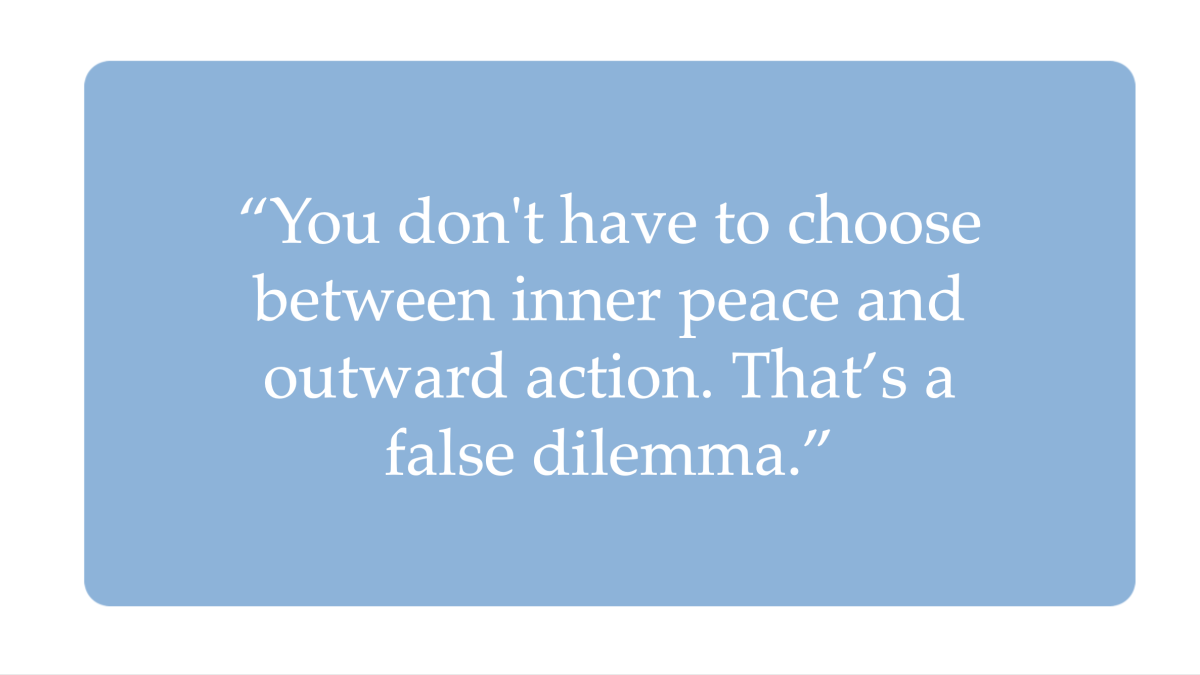
You don't have to choose between inner peace and outward action. That's a false dilemma. The people who have sustained the longest fights for justice, from civil rights to climate to refugee rights, almost all had practices. Prayer. Gardening. Dancing. Sitting in silence. They didn't use these practices to escape from the world, but as sustenance for sustained engagement.
You're allowed to live your life right now. Not someday when things get better, but now. Laugh with your friends. Fall in love. Watch movies. Bake bread. Read books for pleasure. Pursue your dreams, whatever they may be. These aren't distractions from the fight... they're what make the fight worth fighting.
Categories: : Resilience & Habit Change
Continue Exploring
This article is part of a broader body of work exploring:
- mindfulness and contemplative practice
- behavior change and resilience
- embodied movement and nervous system regulation
- financial clarity and practical life skills
- the ongoing challenge of living with greater awareness, wisdom, and intention
If you'd like to continue exploring, you can browse the full collection of articles or join the mailing list to hear about new writing as it's published.