What to Do When Your Brain is Being a Bully
 Jason Ray Brown
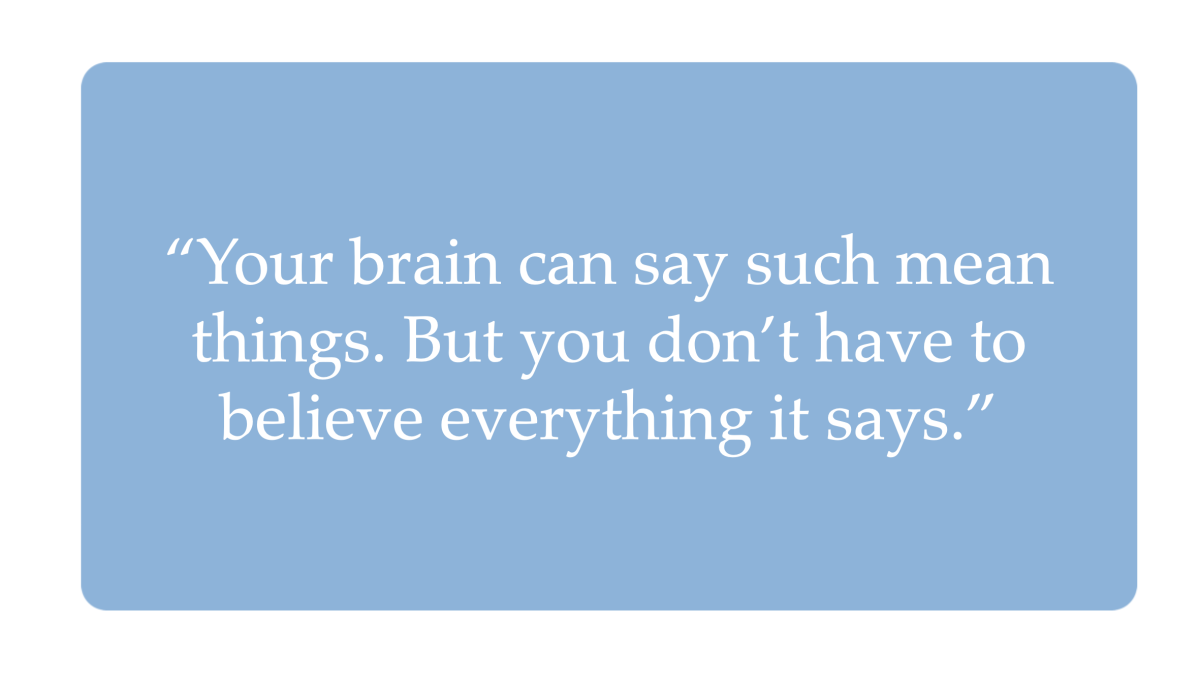
Your brain can say such mean things to you, but you don't have to believe everything it says. Here's a few ACT techniques that can help.
I’ve been thinking about how mean my brain can be to me. If I heard someone say anything remotely close to what my brain says to me all the time to someone I care about, I’d be pretty upset. I might even punch that brain right in the face, if I could figure out where its face is.
But seriously.
My brain says things like:
“You’re washed up, Jason. You’re old, out of shape, and don’t have the same level of energy that younger people have. You’re also not as attractive, and don’t look as good on camera as the 20 and 30 year olds making yoga and movement videos. Maybe you should switch careers and be a bookkeeper. You wouldn’t even need to be on camera if you’re a bookkeeper.”
The thing is, there is SOME truth to all that but it isn’t the whole story about who I am. And regardless of whether ANY of it is or isn’t true, it certainly doesn’t help my self-esteem to be hearing it all the time.
I was leading a coaching group recently, and a woman – let’s call her Caroline – was expressing similar sentiments about motherhood. She told the group that she often has the thought that she’s a bad mom.
Her brain tells her, “you’re a bad mom.”
Whenever she loses her patience with her kids and raises her voice. Or her two sons get in a fight with each other in public – and don’t listen to her when she tells them to stop, which attracts judgmental stares from passers by. When they spend too much time on their phones but she doesn’t tell them to stop because she’s on her own phone and she’s enjoying the silence. And at least they aren’t fighting with each other.
“You’re a bad mom.”
The thought comes up so much that she believes it.
Her husband and her friends tell her it isn’t true. She herself has tried to convince herself that it isn’t true. She has journaled about all the things that she does for her kids, about times when she was patient, about the things her kids have achieved. And she knows intellectually that it’s not true. But regardless…
“You’re a bad mom.”
The thought is still there.
So what is she supposed to do? What can any of us do when these kinds of thoughts arise?
Don’t fight the thought.
ACT (Acceptance and Commitment Therapy) offers an amazing remedy for this kind of dynamic. Instead of trying to suppress the thought, or convince yourself that it isn’t true, you just allow it to arise. It’s going to anyway, so why fight it? However, after the thought arises just create a bit of space between yourself and the thought by repeating it but with a few additional words in front.
So “you’re a bad mom” becomes, “I’m having the thought that I’m a bad mom.”
“You’re old and out of shape” becomes, “I’m having the thought that I’m old and out of shape.”
By adding “I’m having the thought that…” in front, you create a little bit of distance between yourself and the thought. You “defuse” from it.
Fusion with a thought is when the thought is so close to you that you think you are the thought.
“You’re a bad mom” becomes “I am a bad mom.”
Whereas,
“I’m having the thought that I’m a bad mom” allows you to step back and recognize that this is just a thought. You have lots of thoughts. Just because you have thoughts, doesn’t mean those thoughts are true.
Another great technique for defusing from a thought is to write it down on a piece of paper. After you write it down, hold it up right in front of your face and read it. This is what fusion feels like. The thought feels like it’s part of you. Next, go place the paper with your thought on it somewhere on the other side of the room and walk back to where you were standing. Now look at the paper that has the thought on it, but also take in the rest of the room… all the furniture, the light, the space. This is what defusion feels like. The thought is still there, but it’s not the only thing there.
And most importantly, it’s just a thought.
Is it useful?
Rather than debate whether or not a thought is true, another great ACT technique is to ask yourself:
Is this thought useful to me in this moment?
Will it help me do what needs to be done?
Will a thought like “I suck at this” help me…
Write this article? Create that video? Teach my kids how to share?
Most likely not.
We don’t need to fight with our thoughts, get entangled with them, or spend time with them – especially if they aren’t being nice to us.
And we certainly don’t need to punch them in the face!
Make it silly
Another ACT technique that can help you defuse from self-critical thoughts involves making the thought itself more silly. There are a few ways to do this, but my favorite is using a cartoon voice.
The idea is that you take the recurring negative thought – “I’m a bad mom” or “I’m old and out of shape” – and you repeat it in your head (or out loud) in a ridiculous cartoon voice. Think Donald Duck, a squeaky mouse, a slow sloth, or even a pompous British butler. The content of the thought stays the same, but the emotional weight falls apart because your brain can’t feel ashamed of something that sounds like Elmer Fudd.
It works on the same principle as the “I’m having the thought that…”: you’re not trying to argue with or banish the thought. You’re just changing its texture so it loses its grip.
Humor is a great defuser.
Be on the lookout
Most of the time, when your mind is generating negative thoughts like this you may not even be aware of it. You're focused on doing what you're doing, sometimes while being fully present and sometimes while your minds is elsewhere.
But it's possible that your bully-brain is lurking just under the surface, waiting for an opportunity to jab you with a critical word or phrase.
The next time you start to sense that this might be happening, try one of above techniques. They won't make the thought disappear, but they will help you create some distance so you don't feel like the thought represents the truth of who you are.
Categories: : Resilience & Habit Change
Continue Exploring
This article is part of a broader body of work exploring:
- mindfulness and contemplative practice
- behavior change and resilience
- embodied movement and nervous system regulation
- financial clarity and practical life skills
- the ongoing challenge of living with greater awareness, wisdom, and intention
If you'd like to continue exploring, you can browse the full collection of articles or join the mailing list to hear about new writing as it's published.